







by admin
Every LHD is intended to conform to the values and desires of the neighborhood it applies to. If we had an LHD, what should it look like?
Based in part on the work done by the Pemberton Heights Neighborhood Association, WANG has defined the following set of Guiding Principals for what we think our neighbors would want – and would not want – in an LHD. Is this what you want? Please review and let us know.
Outreach/Process
“Our goal is to maintain the uniqueness of West Austin, the quality of life that comes from that uniqueness, and the value of owning a home in this neighborhood. The City has written the LHD ordinance to create incentives for preservation of historic areas of Austin. Each historic district creates its own unique Preservation Plan. By forming an LHD and developing a Preservation Plan, neighbors are agreeing to restrict their own building options in exchange for having similar restrictions applicable to all other building projects in the neighborhood.
“The Board will guide the development of the Preservation Plan in a way that encourages input from all affected property owners from the proposed LHD, with the goal of developing a Preservation Plan that reflects the broad consensus values of the affected property owners from the proposed LHD.”
Property Values
“The intent of the LHD is to enhance property values for homeowner-residents by creating and maintaining a neighborhood sought by potential residents not only for its convenient location but also for its unique community of authentic historic homes and sympathetic newer construction.
“Recognizing that historic preservation requires a shared commitment and vision by those affected, the LHD is intended to favor investment in the neighborhood by owner-residents over the financial interests of development speculators.”
Predictability
“The Preservation Plan will provide clarity and predictability regarding new construction, remodeling, and preservation in the neighborhood, and should reduce the need for neighbor to confront neighbor over development proposals. The plan should not be burdensome or time-consuming to those who comply with it.”
Landscape and Amenities
“We will look for ways to maintain the tree cover and the open public and private landscaping that currently exist in West Austin. We will seek opportunities to keep traffic noise levels down and provide historically sensitive public amenities as part of the Preservation Plan.”
Lot Size
“The Preservation Plan will maintain the traditional arrangement and rhythm of houses along streets in West Austin. Except for undeveloped tracts, lot splits, combining lots, or creating lots that do not front on a street will be strongly discouraged.”
Neighborhood “Feel”
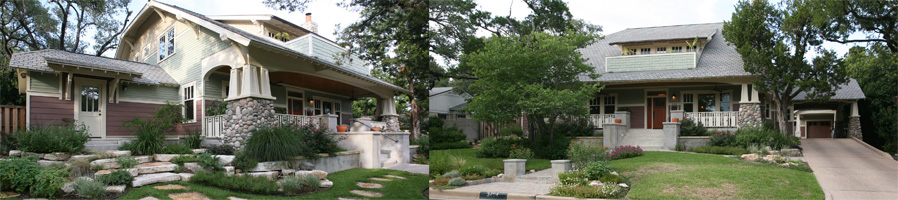
“A primary goal of the guidelines on lot size, scale of house to yard, architectural style, and open landscaping is to preserve the neighborhood’s unique character, which is created by the narrow streets, mature trees, uniform set-backs, and diversity of historic architectural styles.”
Scale: House and Yard
“The design guidelines will identify and quantify the setbacks, heights, and building mass relative to lot size generally used by contributing homes in the neighborhood, and provide standards for new construction so that the traditional proportions of landscape to improvements in the neighborhood are respected. It will encourage the traditional orientation of homes on lots, the open front yards customary in the neighborhood, and the preservation of mature trees.”
Architectural Design
In order to protect the historic integrity and feel of the West Austin neighborhood, we foresee new design guidelines defining set-backs, materials, landscaping, fencing, and the overall design of new structures. Our goals in the development of these architectural design guidelines are:
1. That they encourage new construction that is respectful of and sympathetic to the traditional residential design in the neighborhood, while allowing for contemporary interpretations and style.
2. That all new design guidelines be objective and measurable, so that it is obvious when a structure is in compliance and when it isn’t. We are opposed to subjective guidelines that add uncertainty to the design and construction process.
3. That the guidelines be simple and focus on big issues. They should not be ‘fussy’ or too detailed.
Travis County is conducting a survey for how to proceed in the sale or lease of its Palm School site. In various resolutions and planning documents over the past several years, the City of Austin has consistently expressed interest in coordinating with Travis County to preserve Palm School as a public space, particularly because of […]
THESE ARE THE GOOD OLD DAYS By: Cathy Kyle Austin is always best the day you move there. After that, it’s all downhill. Or at least, that’s the way it seems sometimes. You hear folks giving directions according to “where the Stallion used to be” or reminiscing about that great band they heard for the […]
TROWEL & ERROR! On April 2, from 9:30 a.m. to 1:00 p.m., Mayfield Park will host Trowel & Error, the Spring event that annually attracts gardeners from all over Central Texas to hear experts give time-tested tips for beautiful gardens. Although lectures begin at 10:00, the event “opens” at 9:30 for those early birds who […]
Explore the Landscape Legacy of Austin on November 21-22 with a tour of Austin’s historic landscapes, including not only the historic Mayfield Park and Lion’s Municipal Golf Course in our neighborhood, but 25 other significant parks, open spaces, and historic landscapes. Join The Cultural Landscape Foundation, the Austin Parks and Recreation Department, and local partners […]